
Ultra-Endurance Testing: Scaling the Alps with EvoPod
Optimised fuelling for 100-mile mountain trail races.
- Reduced Race Friction
- 42%
- Sustained Energy Efficiency Gain
- 58%

The simple gel holder that changes everything
Pre-tear your gel, load it into EvoPod, and fuel with one hand — no tearing mid-run, no sticky fingers, no wasted sachets.
It’s deliberately simple: a comfortable, grippable pod that carries a standard gel sachet and puts it within easy reach. You decide when to fuel and exactly how much — without stopping, wrestling the wrapper, or losing the moment.
Open the top of your gel before you start.
Slide the sachet into the pod.
Close it — secure and ready.
Squeeze exactly when and how much you want.
No fumbling with tear-notches at 20kph. No half-squeezed gels dribbling down your wrist. Just your gel, ready the moment you are.
Pre-OrderTrying to rip a sachet open at pace — with gloves, sweat or rain in the way — while it slips through your fingers.
Half the gel ends up on your hands, bars and kit. The other half dribbles down your wrist.
Eyes off the trail, speed dropping, balance gone — all because you needed a mouthful of fuel.
Once it’s open, you’re committed. Half-used sachets leak, dry out or get binned — gel and money wasted.
EvoPod holds the sachet you already use — pre-torn, ready to squeeze, one-handed, exactly when you want it.
See How It WorksEvoPod doesn’t change your gel — it just makes it easier to carry, open and control.
Open the top of your gel before you head out.
Slide the sachet into the pod. It just fits.
Close it. Secure, protected and ready.
Squeeze when you want. As much as you want.
No new gels. No new habits. Just your gel — ready the moment you are.
One simple pod. Your gel, held secure and ready — explore every part of it below.
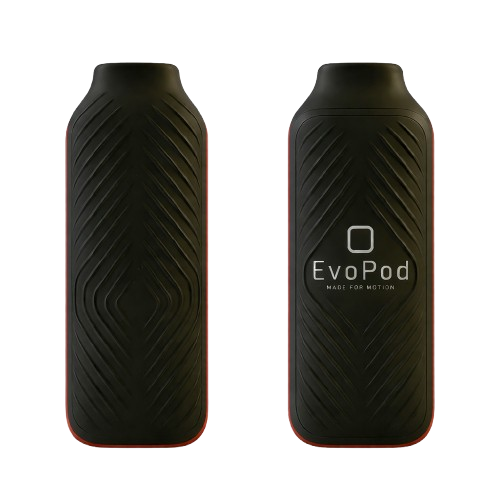
Select a hotspot on the pod to learn what each part does — or switch to “How It Works” to see the simple four-step routine.
YOUR GEL. YOUR WAY.
Control your fuel. Control your race.
EvoPod fits the standard gel sachets you already use. Search your brand below — only verified gels are listed.
14 verified gels · 5 under verification · instant results
No exact match — submit your gel below and we’ll verify it.
Works with the verified gels above — no new gels, no new habits.
Hold and squeeze comfortably, even in rain or with tired hands.
Fits the standard gel sachets you already use and trust.
Pre-torn and protected — the gel opens first time, every time.
Fuel in one small sip or one big hit — you decide, mid-stride.
Your gel rides in the pod, not loose in a pocket or bunched in a waistband. When the moment comes, it's right there — no rummaging, no dropping, no lost sachets.
Pre-torn and locked in, your gel opens first time — even with gloves, sweat or rain. No more saving the awkward tear for a downhill.
With fueling handled, your head is free for the race — the line, the pace, the effort. That's the quiet confidence EvoPod gives you.
Optimised fuelling for 100-mile mountain trail races.

Seamless integration for elite race conditions.
EvoPod transformed my fuelling strategy. No more mess, just power.
The most intuitive piece of gear in my kit.
Precise, reliable, and essential for racing.
It keeps my hands clean and my focus on the road ahead, period.
Finally, a solution that respects the athlete's needs.
I can fuel at full speed without losing grip or concentration.
EvoPod transformed my fuelling strategy. No more mess, just power.
The most intuitive piece of gear in my kit.
Peer-reviewed sports-nutrition research supports taking carbohydrate during prolonged exercise. What the evidence also shows is that how athletes manage that intake varies — and individual needs differ. Explore the two approaches below.
A typical gel sachet is designed to be consumed in one hit — usually early or mid-session. The whole dose arrives at once, and once it's open, you're committed.
Same gel, same total carbohydrate — only how you access it changes.
Research shows carbohydrate intake during prolonged exercise can support endurance performance, and that managing delivery across a session may help some athletes — with some studies associating more frequent intake with reduced gastrointestinal discomfort. Requirements vary by duration, intensity and tolerance, and the research does not prove smaller doses are universally better.
EvoPod doesn't change the nutritional content of your gel. It simply gives you another way to access it — dosing little and often or all in one go, mid-stride, one-handed.
A widely cited review setting out evidence-based carbohydrate recommendations during exercise — typically 30–90 g per hour for prolonged events — while stressing that optimal intake depends on duration, intensity and the individual.
Reviews why GI distress occurs during exercise and how the amount, concentration and frequency of carbohydrate consumed influences symptoms — larger, concentrated doses are more often implicated.
The IOC-endorsed consensus on carbohydrate periodisation — confirming the performance benefit of carbohydrate during prolonged exercise and recommending athletes individualise intake to their event and tolerance.
Systematically links exercise stress and nutritional practices — including large carbohydrate loads — to GI symptoms, underlining why many athletes experiment with how and when they take fuel.
Your fuel. Your strategy. Your control.
Build your personal fuelling target based on your session, not a generic number.
Estimated time: —
50g / hour
SUFFICIENT CAPACITY
You don't have to blindly follow a rigid gel schedule. Use your full gel when you want the bigger carbohydrate hit. Use EvoPod when you want a smaller dose between full gels.
Fuel according to the plan. Adapt according to the moment.
The repeating pattern of your strategy — full gels for the big hits, EvoPod for smaller doses in between.
The whole strategy first — select a phase to see the detail.
Enter your session details and press Calculate to build your journey.
THE NEXT QUESTION IS HOW YOU WANT TO TAKE IT.
You don’t have to blindly follow a rigid gel schedule. Use your full gel when you want the larger carbohydrate hit. Use EvoPod when you want a smaller dose between full gels. If your stomach feels good, continue. If a larger hit feels like too much, adapt. If terrain, intensity or conditions change, adapt.
Respond to what your body needs rather than blindly following a fixed schedule.
Smaller, more frequent delivery can provide an alternative to repeatedly taking large carbohydrate hits.
Think about how carbohydrate delivery is distributed rather than simply chasing large individual doses.
Maintain carbohydrate availability throughout the session rather than relying only on occasional large hits.
Change how you deliver fuel without abandoning the overall fuelling strategy.
Keep fuel immediately available when you need it.
Fuel according to the plan. Adapt according to the moment.
This calculator provides general educational guidance, not individual medical or nutritional advice. Carbohydrate requirements vary between athletes and sessions. Test your fuelling strategy in training and seek personalised advice from a qualified sports nutrition professional where appropriate.
EvoPod does not change the carbohydrate content of your gel — it simply changes how you access it.
YOUR FUEL. YOUR TARGET. YOUR CONTROL.

Glycogen depletion is gradual — so fuelling should be too. Taking gel in small, controlled amounts keeps blood sugar stable and avoids the stomach distress that comes from downing a full sachet in one go. EvoPod lets you dose exactly as much as you need, exactly when you need it.

Tear-notch battles cost more than time. Eyes leave the trail, grip loosens, cadence drops — and a single sticky fumble can break a rhythm that took kilometres to build. Pre-tearing your gel before the start removes that moment entirely.

Wet, sweaty or gloved hands struggle with thin, slippery foil wrappers. A wider, textured body is dramatically easier to hold — which is why EvoPod is shaped to be gripped and squeezed comfortably, even in rain, at 20kph, with tired hands.

Once a sachet is open you're committed — but a whole gel is often more than the moment calls for. Half-used gels leak, dry out and get binned. Dosing from a sealed, protected pod means nothing is wasted and nothing spills in your pocket.
Every year, thousands of discarded gel sachets end up strewn along race routes and trails. EvoPod offers a simple, practical way to keep that packaging contained.
EvoPod is designed to be used again and again. Load your gel, fuel your race, reload for the next one — the pod stays with you, not in the hedge.
The empty sachet goes back into the pod until you reach a bin. No fumbling with a crumpled wrapper mid-run — and nothing dropped on the course.
Fewer discarded wrappers means less litter for volunteers to collect, tidier routes for local communities, and a better environmental story for your event.
If you're a race director or event organiser looking for a practical way to cut gel-wrapper litter, protect your course and improve the environmental experience of your event — we'd love to talk. EvoPod can be incorporated into your event strategy, from athlete communications to on-course waste reduction.
Get In TouchProduction-ready EvoPods are coming. Secure yours now — waitlist members receive 50% off at checkout.
One pod. Pre-tear, load, lock and fuel — the gel sachets you already trust, carried better. Waitlist members get 50% off their first EvoPod.
Payments are processed securely by Stripe. EvoPod never sees your card details.
Your gel. Your physiology. What happens next?
Every energy gel contains a known amount of carbohydrate. But how your body digests, absorbs and uses that fuel depends on more than the number printed on the packet. Explore the science, personalise your fuelling profile and discover what the evidence can tell you.
How much carbohydrate you consume. This is the one number you can know exactly — it's printed on the sachet.
How carbohydrate is transported from the gut into the body. Measurable in a laboratory, but not from personal metrics alone.
How much ingested carbohydrate is used to produce energy. Depends on intensity, duration, formulation and training status.
You know what's in your gel. But what can you actually know about what your body does with it?
Select a verified product, set your quantity and build a physiology profile. Exact intake calculations are always separated from physiological estimates — and where the science can't give you a personal number, we say so directly.
Manual entry — user supplied, not independently verified.
Self-reported gut tolerance is useful context, but it is not a direct measurement of intestinal absorption. You can reset your profile at any time below.
This curve is a purely hypothetical illustration of how a fixed quantity of carbohydrate might appear in circulation over time under an assumed uptake half-time. It is not a measurement, not a prediction, and it does not represent your absorption.
Assumption: cumulative appearance follows a first-order saturating curve, C(t) = 100 × (1 − 0.5^(t/τ)), where τ is the assumed half-time you set above. No validated model applies this to individual gel intake from personal metrics. Show Mode A for the evidence-based view.
Substrate use and responses to endurance exercise may vary with intensity, training status, body composition and energy availability, hormonal environment, exercise duration, carbohydrate formulation, gastrointestinal tolerance and prior fuelling practice. Classic tracer work reported that, at moderate intensities, untrained women oxidised proportionally more fat and less carbohydrate than men under the same conditions — but trained populations, higher intensities, menstrual-cycle phase and formulation all modify this, and some later studies find smaller or no differences.
What the evidence does not support: a fixed percentage difference in absorption between men and women, or the claim that one sex "needs" a specific intake. Sex alone does not determine optimal fuelling — duration, intensity and individual tolerance matter more.
See: Tarnopolsky LJ et al., J Appl Physiol 1995 — limitations: small sample, untrained participants, single intensity, no female-specific formulation data. Full citation in the science section below.Note: EvoPod changes how an athlete accesses and dispenses their existing energy gel. Smaller, more frequent portions may suit some fuelling strategies, but they do not automatically increase absorption or improve performance.
Enter a duration and target intake to see your fuelling plan.
25 g of carbohydrate consumed is not 25 g absorbed in that moment. Tap each stage:
Glucose is absorbed via SGLT1 transporters; fructose via GLUT5 — a separate intestinal pathway. Because the two sugars use different transporters, formulations combining them (typically as maltodextrin + fructose) can raise the total carbohydrate your gut can handle per hour compared with a single sugar, a finding supported by tracer studies of combined glucose–fructose ingestion. Manufacturer-stated ratios, where published, appear in the product database above. Where a manufacturer does not publish the breakdown, E-LAB shows "Not disclosed" rather than guessing.
Same total carbohydrate, three schedules:
Six pillars, from conceptual framework to practical decisions:
Conceptual pillar — knowing exactly what and how much you're taking. Your gel's label is fact; your response is individual.
How often you dose. Research on dose frequency and GI comfort is mixed; EvoPod lets you explore schedules rather than commit to one.
How quickly the stomach passes fuel. Influenced by concentration, volume, intensity and hydration — documented in GI physiology literature.
SGLT1 and GLUT5 capacity. "Gut training" research suggests transporter capacity can adapt with habitual high-carbohydrate intake.
What circulates and reaches working muscle. Measured with tracer methods in labs — not predictable from personal metrics.
Exogenous carbohydrate can spare liver glycogen during prolonged exercise — a consistent finding in tracer studies, with magnitude varying by dose and duration.
GLITCH AF is EvoPod's conceptual framework. EvoPod itself is the physical delivery layer — it dispenses the gels you already trust; it does not measure absorption or determine your optimal intake.
Where the evidence is uncertain or incomplete, we say so. Every physiological claim on this page maps to a source below.
Sets the widely used guidance framework: ~30–60 g/h for sessions of roughly 1–2.5 h, extending towards 90 g/h for longer events when multiple-transportable carbohydrate formulations and individual tolerance support it. E-LAB's guidance checks are based on this framework.
Limitations: population-level guidance, not individual prescription.
Read the source →Reviews evidence that the gastrointestinal tract can adapt to habitual high-carbohydrate intake, with implications for transporter capacity and comfort during exercise.
Limitations: adaptation protocols and magnitude vary between studies; individual responses differ.
Read the source →Found higher exogenous carbohydrate oxidation when glucose and fructose were ingested together versus a single sugar — the basis for multiple-transportable formulations.
Limitations: trained male cyclists, fixed laboratory intensity; findings may not generalise to all athletes or real-world fuelling.
Find on PubMed →Reported sex differences in substrate utilisation at moderate intensity — the basis for the "Explore physiological differences" panel.
Limitations: small sample, untrained participants, single intensity, no female-specific formulation data; later research finds context-dependent results.
Find on PubMed →Summarises exercise-induced gastrointestinal symptoms, their relationship with carbohydrate dose and concentration, and emerging gut-training protocols.
Limitations: heterogeneity of protocols; symptom reporting is subjective.
Find on PubMed →Carbohydrate quantities, sachet sizes and formulation notes in the calculator database come from official manufacturer product pages and packaging. Formulations change — verify against your current sachet.
Example: SiS product pages →Privacy: the calculator works without registration. Your physiology inputs stay in your browser — E-LAB does not transmit personal data to third parties, does not diagnose medical conditions, and stores nothing unless you ask it to.